Over 12 million visitors flock to Barcelona’s modernist landmarks annually, yet most miss the intricate details that reveal the genius of Gaudí and his contemporaries. Standing before Casa Milà or Park Güell, travelers often experience ‘architectural blindness’ – overwhelmed by the spectacle but unable to decipher the organic forms, Masonic symbols, and naturalist motifs that make these UNESCO sites revolutionary. This disconnect matters because understanding these elements transforms your experience from passive sightseeing to active discovery, revealing how Barcelona’s architects encoded Catalonian identity, religious mysticism, and scientific principles into every wrought-iron balcony and trencadís mosaic. The frustration of missing these narratives is palpable in crowded Instagram posts where visitors later realize they photographed masterpieces without truly seeing them.
Cracking Gaudí’s organic code in stone and iron
Gaudí’s buildings breathe with biomimicry most observers overlook. At Casa Batlló, run your hand along the skull-and-bones balcony railings – these aren’t mere decoration but represent Saint George’s dragon victims, with the building’s scaled roof as the vanquished beast. The undulating attic’s whalebone ribs serve structural and symbolic purposes, mirroring the dragon’s carcass. Nearby at Casa Milà, the wrought-iron seaweed motifs on ‘La Pedrera’s’ gates aren’t abstract art but precise studies of marine life Gaudí observed during morning swims. These details reflect his ‘nothing is invented’ philosophy, where every element connects to nature’s mathematical perfection. Train your eye to spot how columns branch like trees in Sagrada Familia’s nave, their angles calculated using the same parabolic geometry found in sunflower seed spirals.
View all Tours
Trencadís mosaics – more than broken tiles
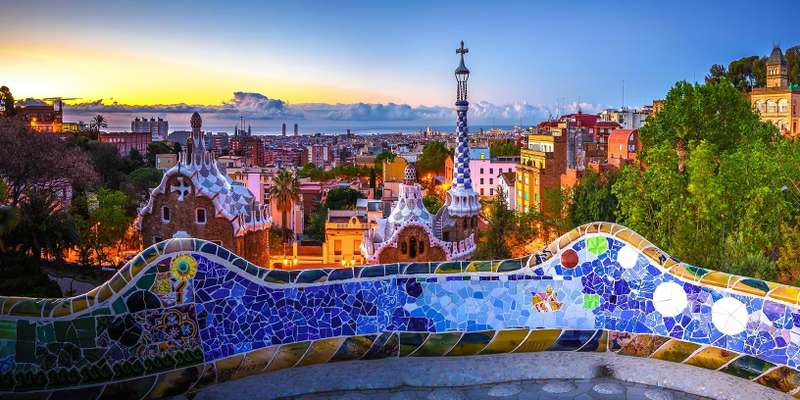
The shimmering mosaics covering Park Güell’s benches and dragon fountain represent Modernisme’s political manifesto in ceramic fragments. Local artisans used discarded tiles from Barcelona’s factories, transforming industrial waste into democratic art accessible to all classes. Look closely at the dragon’s colorful scales – the random patterns follow strict color theory principles, with warm hues placed to maximize morning light reflection. Domènech i Montaner perfected this technique at Hospital de Sant Pau, where patient recovery gardens feature therapeutic color combinations in their trencadís. For DIY spotting, visit the less crowded Palau de la Música Catalana’s columns, where mosaic oranges and lemons symbolize Catalonia’s agricultural wealth, deliberately positioned at eye level for maximum impact.
View all Tours
Secret symbols in stained glass and ceilings
Modernist architects hid Masonic compasses, alchemical symbols, and Catalan nationalist imagery where most tourists never look up. The Hospital de Sant Pau’s domes conceal a celestial map of the 1909 night sky when construction began, visible only when sunlight hits the stained glass at specific hours. At Casa Amatller (next to Casa Batlló), the stepped gable isn’t just Dutch-inspired – its chocolate bar design honors the owner’s cocoa empire, with ceramic tiles mimicking wrapped candy. For free access to spectacular ceilings, visit the often-overlooked Recinte Modernista Sant Pau’s administration building, where glass prisms in consulting rooms created early ‘light therapy’ for tuberculosis patients, their angles precisely calculated to maximize winter sun exposure.
View all Tours
Decoding the Sagrada Familia’s stone gospels
Gaudí’s unfinished masterpiece encodes biblical narratives in its portals so detailed, they’re called ‘stone Bibles.’ The Nativity Facade’s turtle and tortoise sculptures aren’t whimsical decorations – they represent terrestrial and marine stability beneath the Holy Family. At dawn, sunlight activates hidden symbolism: the ‘Magic Square’ on the Passion Facade’s crypt wall isn’t a sudoku puzzle but a mathematical cipher where all rows sum to 33 (Christ’s death age). Local guides note how the Glory Facade’s proposed ‘Seven Deadly Sins’ reliefs will align with sunlight to cast demonic shadows at specific confession times. For budget-friendly access, attend evening mass when the stained glass transforms the nave into a kaleidoscope, with the blue-toned Virgin Mary window strategically placed to receive the last daylight.
UPDATES FOR YEAR 2026
New Access Protocols and Landmark Milestones for Architecture Enthusiasts
As the city celebrates the centenary of its most famous architect, several logistical shifts impact how visitors interact with these masterpieces. The skyline has officially reached its peak with the structural completion of the Tower of Jesus Christ at the Sagrada Familia, making it the tallest church in the world at 172.5 meters. Travelers should note that traditional on-site ticket booths have been phased out at major landmarks like Park Güell and Casa Batlló; all entries now require digital reservations for specific 30-minute windows to manage capacity. Additionally, the city’s designation as a global architectural capital has introduced a calendar of temporary immersive exhibitions and nocturnal light mappings that reveal previously hidden geometric details of the Modernist facades. Visitors should also account for the updated municipal tourist surcharge, which directly funds the continued preservation of these UNESCO-listed cultural assets.
View all Tours
FAQ 2026
Is the Sagrada Familia fully completed in 2026?
While the entire basilica is not finished, 2026 marks a major milestone with the structural completion of the Tower of Jesus Christ. This central tower, topped with a four-armed cross, makes the building the tallest church in the world, though the Glory Facade is expected to take another decade.
Can I buy tickets at the gate for Park Güell in 2026?
No, on-site ticket sales for the Monumental Zone have been discontinued. All visitors in 2026 must book tickets online in advance. It is critical to arrive within the 30-minute entry window specified on your digital ticket to ensure access.
How much is the Barcelona tourist tax for visitors in 2026?
Starting in early 2026, the municipal surcharge has increased to approximately €5 per person per night for most accommodations, though it can reach up to €15 when combined with the general regional tax. These fees are typically collected digitally or at check-in to support sustainable tourism initiatives.
Written by Barcelona Tours Editorial Team & Licensed Local Experts.
Last updated: 24/02/26
